Have you tried to create textured, expressive paintings but felt unsure where to begin with a palette knife?
Top 10 Palette Knife Painting Ideas For Beginners (With Step-by-Step Tips)
This guide gives you clear, professional instruction on how to use a palette knife to create ten approachable painting projects. You will receive practical step-by-step tips, material recommendations, technique breakdowns, troubleshooting suggestions, and practice exercises to build confidence and skill.
Why palette knife painting is a great starting point
palette knife painting lets you work with bold shapes, textured surfaces, and simplified forms, which reduces the pressure on perfect drawing skills. You will learn to manipulate paint thickness, edges, and texture to create expressive work that holds up in galleries and home displays.
What you will gain from this guide
You will receive ten curated painting ideas tailored for beginners, each with a clear sequence of steps and recommended colors and knife types. You will also gain foundational techniques, maintenance tips, and troubleshooting strategies to accelerate your learning curve.
Essential materials and why they matter
Choosing the right materials streamlines learning and prevents frustration. The table below summarizes the core supplies, their purpose, and recommended options so you can assemble an efficient starter kit.
| Item | Purpose | Recommended options |
|---|---|---|
| Palette knives (set) | Apply, scrape, and shape paint; varied tips for techniques | Triangular, diamond-tip, and straight spatula; stainless steel blades |
| Acrylic or oil paints | Main media; oil gives longer working time, acrylic dries faster | Student or artist-grade cadmium-like abstracts, phthalo blues, titanium white |
| Stretched canvas or canvas panel | Painting surface | 8×10 to 16×20 for practice; primed canvas or gessoed panel |
| Palette | Mix paints and keep colors organized | Wooden, glass, or disposable palette paper |
| Mediums (for oil) | Thin or thicken paint; extend or alter drying time | Linseed oil, alkyd medium, or solvent alternatives like Gamsol |
| Retarder (for acrylics) | Extend working time for blending | Acrylic retarder medium |
| Rags and paper towels | Clean knife and control paint | Lint-free rags, paper towels |
| Container for solvents/water | Clean knives and reduce waste | Two jars — one for cleaning, one for rinse |
| Varnish and brushes | Protect finished work; apply varnish with control | Spray varnish or brush-on varnish, soft bristle brush |
| Easel or flat table | Support surface while you work | Tabletop easel or flat work station |
Choosing the right palette knives
Selecting the right knives for the techniques you want to learn will help you achieve consistent results. You will find that a small set covering several shapes is more useful than a single large knife.
| Blade shape | Typical uses | Recommended blade width |
|---|---|---|
| Diamond/pointed | Fine lines, openings, small details | 0.5–1 inch |
| Straight spatula | Smoothing, large strokes, background coverage | 1–2.5 inches |
| Rounded tip | Soft edges, scumbling, curved marks | 0.75–1.5 inches |
| Offset handle | Keeps knuckles away from wet paint and offers leverage | Any blade width |
Preparing your workspace and canvas
A consistent workspace reduces interruptions and helps you focus on mark-making. Arrange lighting, ventilation, and cleaning supplies before you begin, and prime your canvas if needed.
You should stretch or buy pre-primed canvases and make sure your workspace allows you to move the knife freely across the surface. Consider working on multiple small canvases to practice a variety of techniques without committing to a large piece.
Basic palette knife techniques you must practice
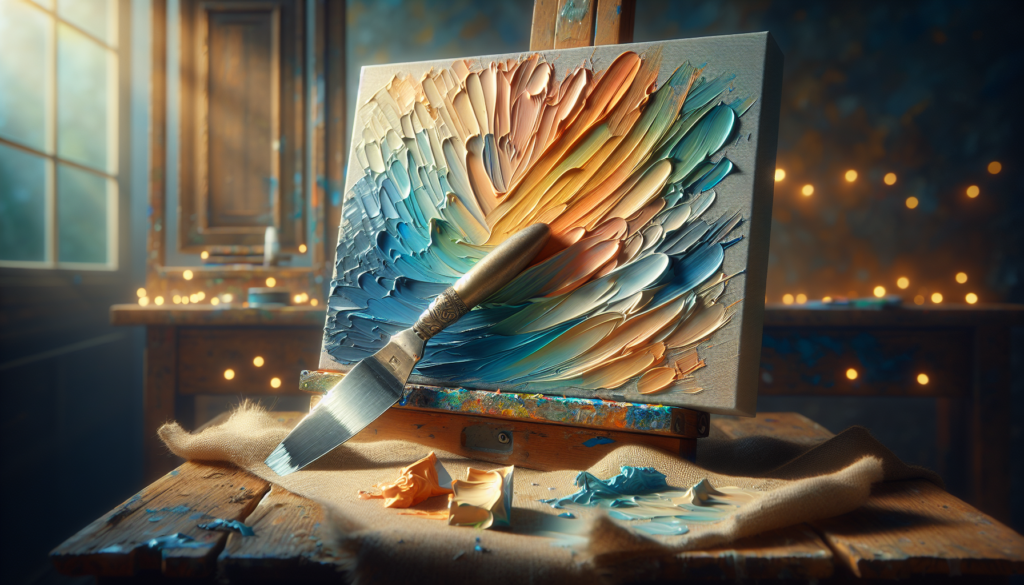
Familiarizing yourself with a handful of basic moves will let you compose a wide variety of effects. You will want to practice loading, spreading, scraping, and creating edges.
- Loading the knife: Load paint onto the edge or flat of the blade, observing how thickness affects marks.
- Spreading/impasto: Press paint onto the surface to build texture and volume without flattening the stroke.
- Scraping and sgraffito: Remove paint to reveal underlying layers or to make lines through wet paint.
- Feathering and blending: Use the edge to soften transitions and combine colors directly on the canvas.
How to load and hold the knife
How you hold and load the knife determines the quality of your marks. Hold the knife like a pencil for controlled lines and at a broader grip for energetic, expressive strokes.
Load the knife with a thin ridge or a full scoop depending on the desired opacity. Practice adjusting the angle between the blade and canvas — a shallower angle creates a thin smear, while a steeper angle deposits thicker paint.
Understanding paint consistency and color mixing
Paint consistency dramatically affects how the knife behaves and the texture you achieve. You will learn to adjust paint body for desired effects and mix colors confidently.
- For acrylics: Use a retarder or gel medium to increase working time and body. Thicker gels will support impasto.
- For oils: Add medium to thin paint or use less medium for thicker, buttery textures.
- Mixing: Mix base colors on a palette and test small amounts on scrap canvas to confirm values and temperature before applying to your main painting.
Safety and cleanup basics
Adhering to safety practices prevents health issues and keeps your tools in working order. Dispose of solvents properly and clean knives while paint is still wet to avoid buildup.
Use a dedicated solvent jar for oils and a water jar for acrylics, and keep a rag handy for immediate wiping. Store blades safely and dry them after cleaning to prevent corrosion.
How this guide is organized
You will find each of the ten painting ideas presented with a short description, a materials snapshot, recommended knives and colors, and a step-by-step process. Each idea is designed for beginners and builds on previous techniques in the guide.
Summary table: The ten palette knife painting ideas
This table gives you a quick overview of each project, its difficulty level, and the essential technique you will practice.
| # | Idea | Difficulty | Key technique |
|---|---|---|---|
| 1 | Simple Seascape | Beginner | Horizontal scraping and impasto |
| 2 | Sunrise or Sunset Sky | Beginner | Layered color blocking and blending |
| 3 | Textured Mountain Range | Beginner-Intermediate | Layer building and palette knife layering |
| 4 | Abstract Floral Study | Beginner | Bold strokes and color isolation |
| 5 | City Skyline at Twilight | Beginner-Intermediate | Negative space and geometric scraping |
| 6 | Snowy Pine Trees | Beginner | Knife-drawn foliage and highlights |
| 7 | Still Life — Fruit Bowl | Beginner | Controlled edges and reflective highlights |
| 8 | Beach Rocks and Foam | Beginner-Intermediate | Scumbling and scraping for texture |
| 9 | Simple Figure Silhouette | Beginner | Confident profile shaping and background blocking |
| 10 | Textured Landscape with Path | Beginner-Intermediate | Directional strokes and perspective through texture |
Technique prerequisites before starting projects
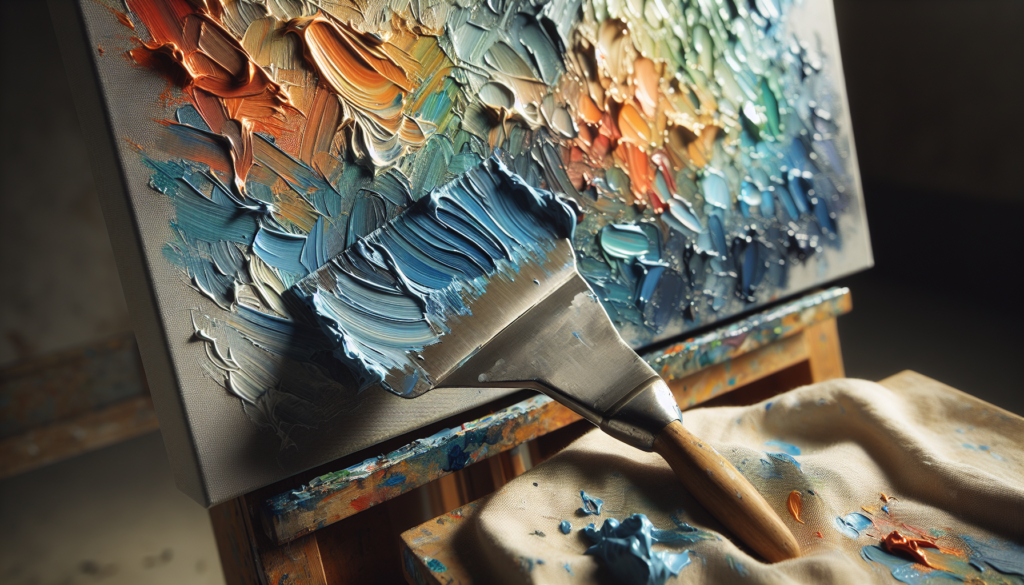
Practicing a few simple drills will make each project less intimidating and teach you how the knife, paint, and surface interact. Spend at least 15–20 minutes on basic strokes before beginning a painting.
Work through edge smears, ridged impasto strokes, controlled points, and scraping to reveal underneath layers. These drills will reduce the number of technical problems you encounter during an actual painting.
1. Simple Seascape
This seascape focuses on horizontal movement and layered color to create the illusion of water depth and sky. You will practice controlled horizontal strikes and gentle blending with a palette knife.
Materials you will need include a medium canvas (11×14 or 12×16), a straight spatula knife and a diamond tip for detail, and a limited palette (titanium white, ultramarine blue, cerulean blue, phthalo blue, a touch of burnt sienna or raw umber for grey tones). Keep your strokes primarily horizontal and use the knife edge to define the horizon.
Step-by-step tips:
- Block in the sky with a light blue using horizontal strokes; keep paint fairly thin to establish a base.
- Add deeper blues for the middle sea area, dragging the knife horizontally and slightly varying pressure.
- Use a lighter mix (white + a touch of blue) for nearer water highlights, placing short horizontal dabs.
- Create subtle foam reflections by dragging a lightly loaded knife with mostly white over the darker area.
- Top up any highlights and soften edges by gently lifting the knife at a very shallow angle.
2. Sunrise or Sunset Sky
This exercise teaches you to build translucent layers and color transitions using the knife to blend and to create dramatic gradations. You will practice flattening and feathering edges without muddying colors.
Recommended colors include cadmium orange (or a near alternative), alizarin crimson or quinacridone, cadmium yellow or lemon yellow, titanium white, and ultramarine blue. Use a small to medium straight spatula and a diamond blade for fine pulls.
Step-by-step tips:
- Lay down a base wash of mid-tone (diluted with medium if oil) across the canvas for the general sky color.
- Apply bands of warm color near the horizon with a scooping motion; do not fully mix them on the palette.
- Use the long edge of the knife to feather transitions upward, softening by slightly dragging the blade through both hues.
- Add thin streaks of cloud color with short, angled strokes and lift edges to suggest light.
- Reinforce a few highlight areas with nearly pure white applied with the knife tip for concentrated luminosity.
3. Textured Mountain Range
You will create stacked planes of mountains using layered palette knife strokes to convey depth and ridges. This project teaches blocking-by-value and how to use texture to separate planes.
Key supplies are a range of earth tones (burnt umber, raw umber, ultramarine mixed for cool shadows), titanium white for highlights, and a medium to large straight spatula. Use thicker paint on closer ridges and thinner mixes for distant ranges.
Step-by-step tips:
- Block the background sky quickly and allow slight drying if using acrylics before starting mountain layers.
- Paint the farthest mountain silhouette with a thin cool mix using broad sweeping strokes.
- Add successive mountain ranges with thicker paint and slightly warmer values, using angled strokes to suggest slopes.
- Create ridgelines with the knife tip and add highlight edges where the light would hit.
- Soften overlaps by feathering the knife lightly across the join where necessary to avoid hard, unrealistic edges.
4. Abstract Floral Study
An abstract floral study simplifies flowers into shapes and color accents; you will concentrate on economy of stroke and expressive color placement. This exercise helps you loosen up and rely on color relationships rather than detailed rendering.
Choose vibrant pigments (cadmium red or naphthol red, cadmium yellow, viridian or phthalo green, titanium white) and a small diamond knife for petals plus a medium spatula for background fills. Emphasize gestural marks.
Step-by-step tips:
- Establish a neutral or complementary background color with a few broad strokes.
- Block in flower shapes with bold, single-direction strokes using a loaded knife to create petals.
- Add contrasting centers with dabs of thicker paint, lifting edges to create texture.
- Suggest foliage with quick vertical or diagonal strokes using the knife edge.
- Balance composition by stepping back and adding small color accents to guide the eye.
5. City Skyline at Twilight
This idea emphasizes negative space, geometric shapes, and controlled scraping to create a sense of architecture. You will practice building crisp edges and reflecting lights.
Essential colors include ultramarine, Payne’s gray, titanium white, cadmium yellow for window lights, and a medium straight spatula and diamond tip. Work from background to foreground and reserve for highlights.
Step-by-step tips:
- Paint a twilight sky with a gradient from deep blue at the top to a lighter glow near the horizon.
- Block in building silhouettes with a flat edged knife using vertical strokes, keeping shapes geometric.
- Use the back edge of the knife to score thin windows and scrape small rectangles to expose underlayer highlights for lights.
- Add reflections on water or glass with horizontal dabs of lighter color and gentle smoothing.
- Reinforce edges and add tiny light dots with the knife tip to simulate lit windows.
6. Snowy Pine Trees
This subject teaches you to suggest foliage through stacked palette knife marks and to render snow weight with white impasto. You will learn to control pressure for leaf textures.
Colors: phthalo green, sap green, ultramarine for shadows, titanium white, and a small diamond knife and rounded blade for foliage. Build up tree mass from dark to light.
Step-by-step tips:
- Block the background sky with cool tones to contrast green foliage.
- Paint tree trunks with a vertical scrape of dark brown/black using the knife edge.
- Apply green masses for branches with angled strokes that taper toward the tip, layering darker greens first.
- Add snow by applying thick white on top edges and dabbing with the diamond tip to create clumps.
- Soften any overly sharp edges by dragging a slightly loaded clean knife across some margins.
7. Still Life — Fruit Bowl
A still life teaches you to represent volume, light, and reflective surfaces using the knife. You will practice combining softer blended areas with crisp highlights.
Choose a small canvas, primary colors for fruits (e.g., cadmium red or a warm red, lemon yellow, ultramarine), titanium white, and a straight and diamond knife. Focus on basic shapes rather than details.
Step-by-step tips:
- Block in the tabletop and bowl using broad strokes, establishing shadow direction.
- Place fruit shapes with confident, rounded scoops of paint, keeping values varied.
- Model the fruit with darker tones on the shadow side and lighter tones where light hits; use the knife tip for small reflective highlights.
- Suggest texture on fruit skins with small dabs and tiny scrapes for dimples.
- Add final cast shadows with a thin, cool mix and drag the knife edge to ground the objects.
8. Beach Rocks and Foam
This painting combines heavy texture for rocks with delicate scraping and thin whites to suggest sea foam. You will practice contrasting thick and thin paint applications.
Necessary pigments are warm ochres and umbers for rocks, ultramarine and phthalo blue for water, titanium white for foam, and a medium to large straight spatula and a diamond tip for details.
Step-by-step tips:
- Block in distant water with horizontal strokes, keeping mid tones subdued.
- Build rock masses with thick, textured applications using a scooping motion and layering.
- Add mid-tone shadows between rock planes with darker mixes, scraping to define cracks.
- Apply foam lines with mostly white, pulling a lightly loaded knife to create thin, translucent streaks.
- Refine edges and add tiny white splashes with quick taps of the knife tip.
9. Simple Figure Silhouette
A silhouette piece reduces the figure to confident shapes and expresses mood via color and texture rather than anatomy. You will learn to simplify and to use negative space effectively.
Use a limited palette and a medium diamond or straight spatula to create clean shapes. Focus on silhouette clarity and complementary backgrounds to enhance contrast.
Step-by-step tips:
- Paint a uniform background with gradation or subtle texture using broad strokes.
- Sketch the silhouette lightly with thinned paint to place the figure.
- Fill the silhouette with a more opaque, single-color pass, keeping edges sharp using the knife edge.
- Add minimal highlights or hairline details with the tip if desired, but maintain the silhouette language.
- Balance the composition with small background accents or texture to create context.
10. Textured Landscape with Path
You will combine directional strokes to suggest perspective and a textured foreground path to lead the eye. This project reinforces how palette knife texture can imply distance and material.
Colors include greens, earth tones, ultramarine, and titanium white; use medium and large spatulas and a diamond for detail. Aim for broader textures in the foreground and finer, thinner marks in the background.
Step-by-step tips:
- Establish a sky and distant horizon with thin strokes and soft transitions.
- Lay in background hills with a cooler, thinner mix to push them back visually.
- Build middle ground with thicker, warmer greens using angled strokes.
- Paint the path with directional, textured strokes; use the knife edge to form the centerline and wider marks at the foreground.
- Add highlights and small vegetation marks to increase realism and texture depth.
Troubleshooting common beginner problems
Even with careful preparation, certain issues will recur when you begin working with a palette knife. Knowing simple remedies will keep you painting without frustration.
- Paint looks muddy: Clean the knife between major color changes and avoid mixing complementary colors excessively on the palette. Use separate spots on your palette for strong hues.
- Knife drags paint thinly: Increase paint thickness or reduce the angle of the knife to deposit more paint. Add a medium to thicken where appropriate.
- Unclear edges or lost detail: Let earlier layers partially dry to gain more control, or use a smaller knife for refined areas. Work from dark to light to maintain contrast.
Common mistakes and how you fix them
Many problems stem from impatience or misuse of tools; most have quick fixes. You will gain efficiency by applying corrective steps immediately.
- Overworking: Stop and evaluate with distance; if the surface looks overworked, allow drying and then add a thin glaze or scrape to unify.
- Uneven drying in oils: Use a consistent medium and thin layers to control drying; avoid overly thick impasto until you are confident with support and varnishing.
- Scratches and accidental marks: Keep a rag nearby and gently lift excess paint while wet. If dry, incorporate marks into the composition as texture or scrape them out carefully.
Caring for your palette knives
Proper maintenance extends the life of your tools and ensures cleaner marks. Clean knives immediately after use with appropriate solvent or water and dry thoroughly.
For oils, use a solvent rinse followed by soapy water and a dry cloth; for acrylics, wash with water before paint dries. Store knives in a flat, dry place and periodically check handles for looseness.
Finishing and varnishing your palette knife paintings
Finishing protects your work and can enhance the color depth of impasto surfaces. Allow oil paintings to dry thoroughly—this may take weeks to months depending on thickness—before varnishing. Acrylics generally dry within days and can be varnished sooner.
Use a removable isolation coat if you are uncertain, and select a varnish appropriate to your paint type (solvent-based for oils, acrylic varnish for acrylics). Apply varnish evenly with a soft brush or spray, and allow recommended drying times.
Practice exercises to build knife control
Regular targeted exercises accelerate skill acquisition and muscle memory. Spend short, frequent sessions on these drills to progress quickly.
- Horizontal stroke series: Fill a canvas with horizontal strokes from thin to thick to practice pressure control.
- Edge-to-edge transitions: Create gradients by moving the knife from light to dark across a surface without lifting.
- Texture grids: Create a 3×3 grid of different textures using the same color mixture but varied knife angles and pressures.
- Quick studies: Paint five-minute thumbnails focusing on gesture and mass rather than detail.
How to photograph and present your work
For portfolio or sales purposes, correctly documenting textured work requires attention to lighting and angle. You will capture texture and color accurately with controlled lighting and multiple shots.
Use diffused daylight or continuous LED lights at 45-degree angles to reduce glare and show depth. Photograph both straight-on for composition and at oblique angles to demonstrate texture. Include a close-up crop to highlight knife work.
Next steps for continued growth
After completing these ten projects, you should increase challenges by varying subject matter, scale, and media. You will also benefit from studying works by artists who use palette knives and from experimenting with mixed media underpainting.
Consider attending a workshop, joining a critique group, or setting themed monthly projects to maintain momentum. Keep a progress log with photos to track how your palette knife fluency improves over time.
Final tips for consistent improvement
Consistency of practice and mindful critique of your own work are the fastest routes to improvement. You will learn more by finishing many small paintings than by working endlessly on a single, unfinished piece.
Set realistic practice goals (e.g., one small study every other day), review each piece critically, and list one specific technical issue to work on in the next session. Over time, your confidence with palette knife techniques, composition, and color use will become evident.
Conclusion
You have a structured path from basic techniques to ten concrete painting ideas that will build your skills with a palette knife. By practicing the fundamental strokes, maintaining your tools, and following step-by-step processes for each project, you will gain control over texture, edge, and form.
Begin with the simpler projects, focus on clean palette management and knife control, and progressively attempt more complex compositions. With consistent practice and attention to the troubleshooting and finishing tips provided here, you will develop a distinctive, confident palette knife painting style.