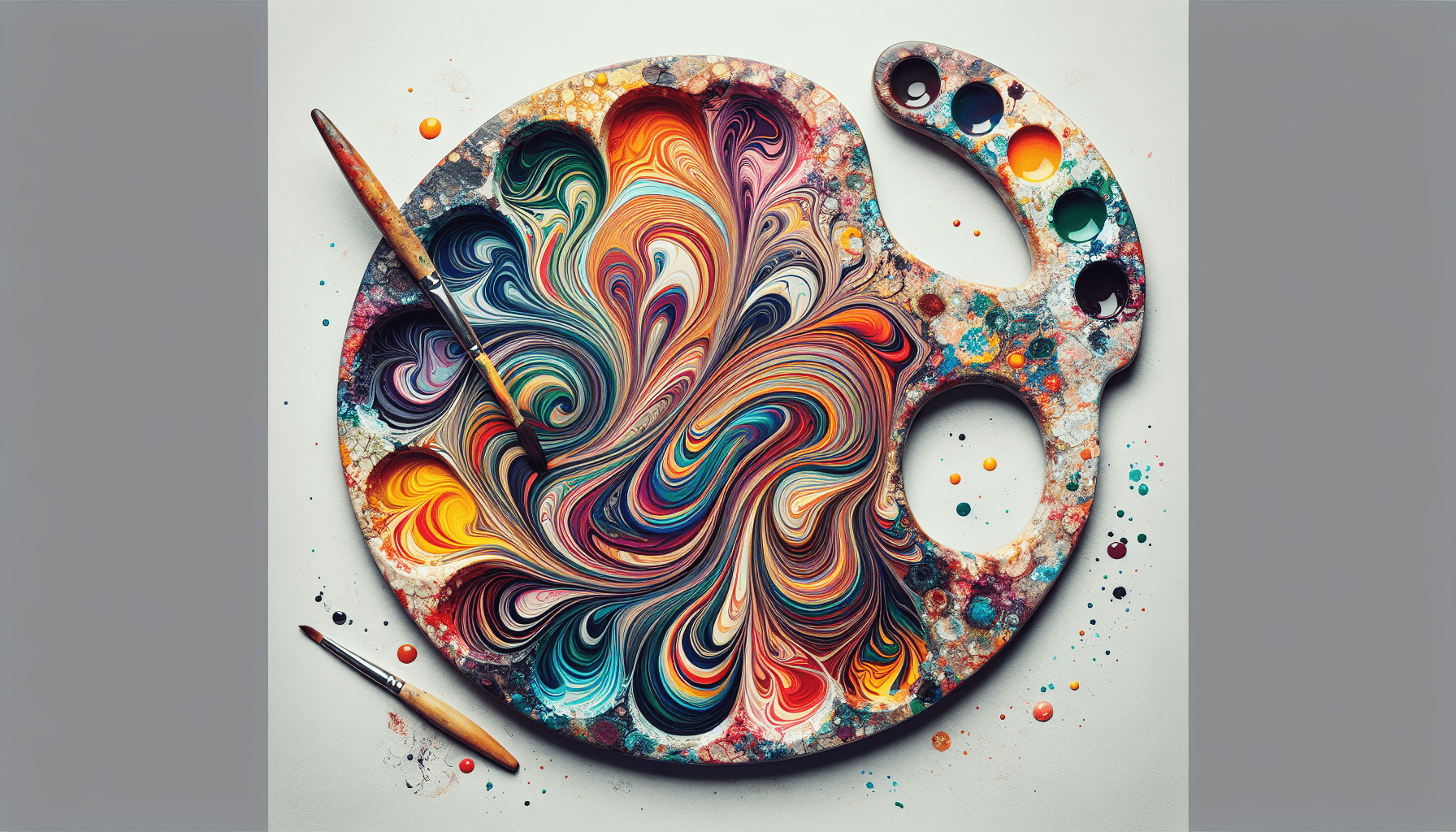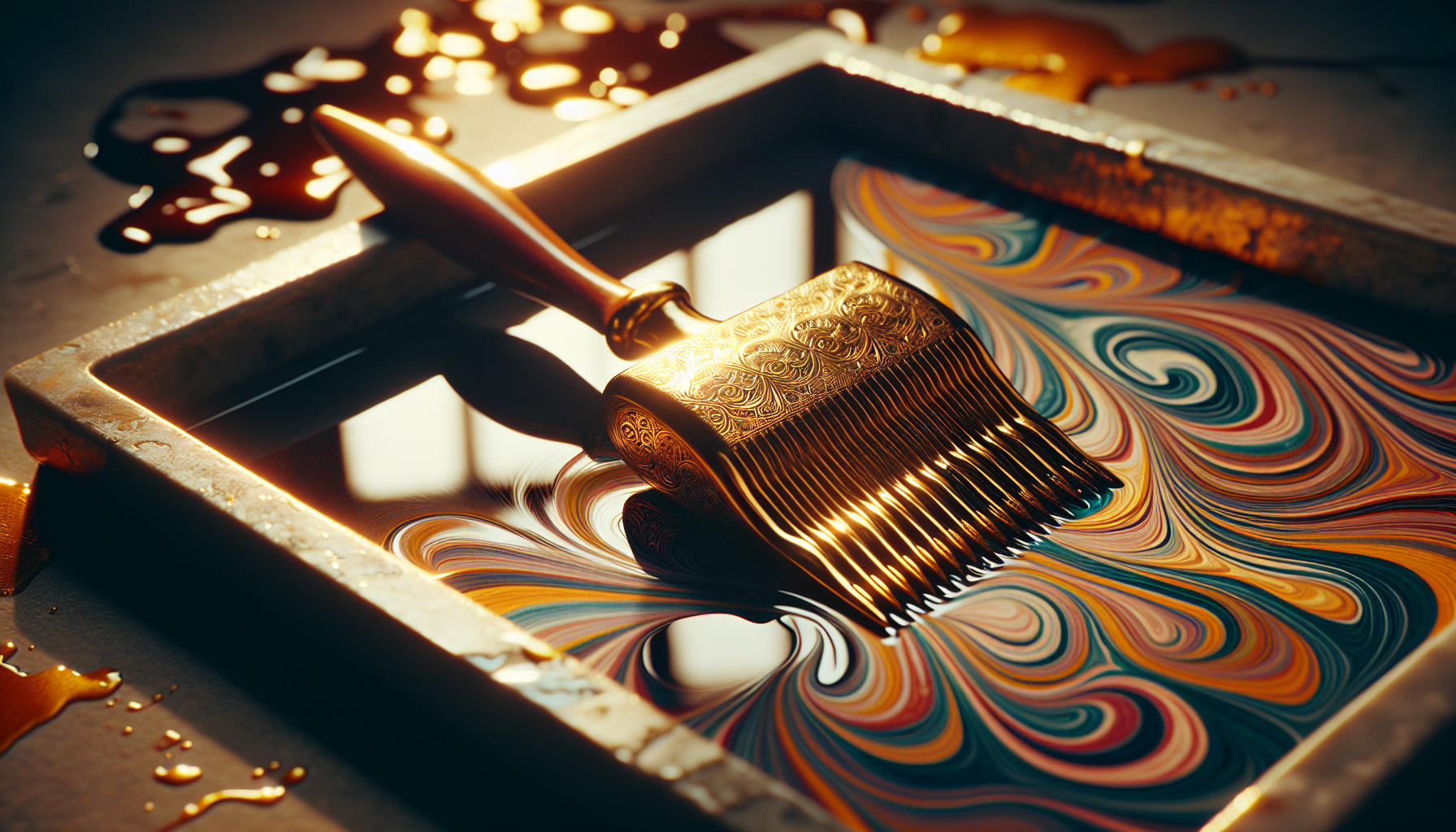
?Are you ready to raise your marbling practice from competent to exceptional by mastering advanced Ebru techniques?
Advanced Ebru (Turkish Marbling) Techniques
This section introduces the scope and goals of advanced Ebru practice. You will find systematic guidance on materials, surface control, complex patterns, transfers, mixed-media combinations, and conservation. The emphasis is on repeatable processes, troubleshooting, and extending the traditional craft into contemporary applications.
Understanding the Principles Behind Advanced Work
To excel in advanced Ebru, you must understand the physics and chemistry that govern the paint behavior on the sizing (the aqueous surface). You will learn how surface tension, viscosity, pigment formulation, and tool geometry interact to produce consistent results. This theoretical foundation makes it possible to innovate with confidence rather than rely on trial and error.
Materials, Tools, and Their Preparation
Having the right materials prepared correctly is essential for advanced results. You will need consistently mixed sizing, stable pigments, well-conditioned brushes and combs, and papers matched to the technique. Below is a practical materials table that lists components, purpose, and preparation tips.
| Material / Tool | Purpose | Preparation / Tip |
|---|---|---|
| Sizing (carrageenan or gum tragacanth) | Creates stable water surface for paint to float | Prepare at least 24–48 hours before use; strain to remove lumps; store refrigerated for short-term stability |
| Pigments (earths, synthetic mineral, acrylic gouache) | Color sources; different pigments behave differently on surface | Grind to smooth paste; mix with distilled water or binder as specified; test each pigment for floatability |
| Ox gall or synthetic surfactant | Improves pigment spreading | Add sparingly (drops) and test; too much collapses patterns |
| Brushes (rose twig with horsehair, synthetic equivalents) | Dropping paint onto surface and making fine strokes | Condition natural brushes by soaking briefly in sizing; shape synthetic ones for desired droplet size |
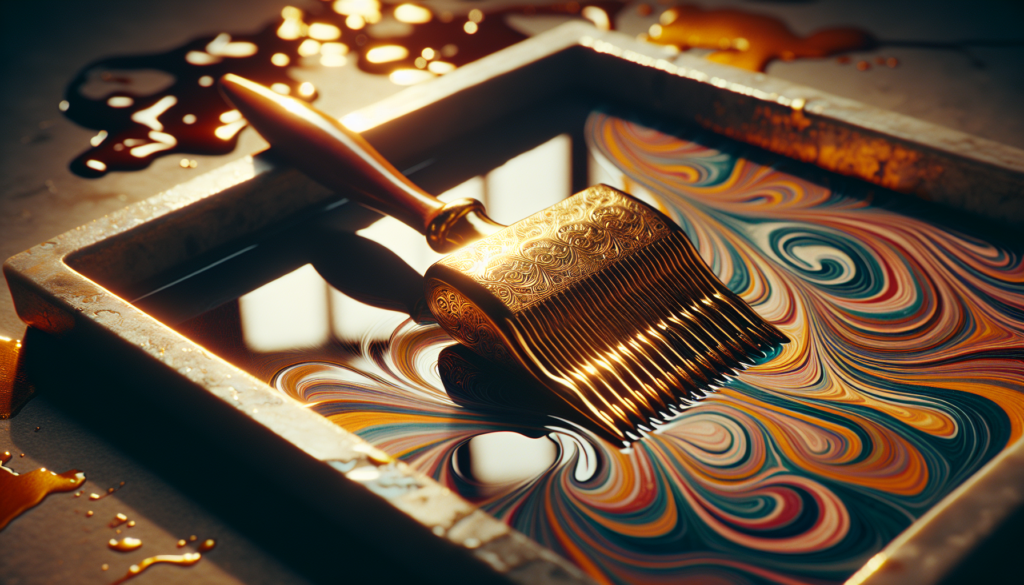
| Combs, rakes, stylus | Creating pattern movements and repeats | Maintain consistent tooth spacing; clean frequently during sessions |
| Paper (cotton rag, watercolor 200–300 gsm) | Accepts transfer from the surface | Pre-wet or press lightly depending on pattern; size some papers for less suction |
| Alum (mordant) | Improves paint adhesion to paper | Apply a dilute alum solution to paper if needed, then dry before transfer |
| Lifting tools (spatula, glass rod) | Lifting, repositioning floating elements | Use smooth, clean tools to avoid tearing patterns |
| Drying rack and flattening press | Post-transfer drying and flattening | Dry flat and out of direct sunlight; use archival interleaving if stacking |
Preparing Sizing: Consistency and Timing
Sizing is central to your success. You will choose between natural gums such as tragacanth and specialized seaweed derivatives like carrageenan. Each has advantages: tragacanth typically yields a slow-moving, stable surface ideal for detailed comb patterns; carrageenan can provide a silkier surface that may speed spreading.
Prepare sizing by dissolving recommended powder ratios in warm distilled water, then allow thorough hydration for 24–48 hours in a covered container. Strain through fine muslin or a nylon stocking to remove undissolved particles that could disturb the surface. Keep the vat covered to prevent dust and skin formation.
Pigment Preparation and Testing
Pigments need consistent particle size and a suitable binder or dispersant. For traditional Ebru, watercolor pigments or finely ground gouache are common. Prepare small test mixtures for each pigment: mix concentrated pigment paste with distilled water and a small amount of surfactant to test spread. Record behavior (fast spread, slow spread, sinking tendency) in a log to guide mixing ratios during work.
Brushes and Tool Conditioning
Traditional Ebru brushes use a combination of a flexible twig handle and a tuft of horsehair. You can replicate that with synthetic materials designed for consistency. Condition brushes by soaking briefly in sizing prior to work; this helps them release paint in predictable drops. Maintain a clean secondary container of sizing for rinsing tools to avoid contaminating the main vat.
Mastering Surface Control
Advanced patterns depend on precise control of the surface. This requires managing temperature, humidity, and viscosity, and actively maintaining cleanliness during sessions.
Temperature and Humidity Effects
Surface tension and viscosity vary with temperature and humidity. You should aim for a stable workshop environment: temperature around 18–24°C (64–75°F) and relative humidity between 40–60%. Cooler temperatures slow spreading and may require more surfactant; higher humidity can increase drying times and cause skin formation on the sizing. Monitor conditions and keep a small digital thermometer/hygrometer near your vat.
Viscosity Testing and Adjustment
Before each session, test viscosity by performing standardized drops: release a consistent droplet of test paint from a fixed height and measure spread diameter after a set time. Maintain a log of formulations and adjustments so you can recreate desired spreads reliably. Adjust viscosity by small additions of sizing (to slow spread) or water/ surfactant (to increase spread).
Maintaining a Clean Working Surface
Even tiny dust particles or floating fibers will disrupt advanced patterns. Use a covered vat between sessions, rinse tools in a separate container, and remove any floating debris with a fine mesh skimmer or a turkey baster. If a skin develops, remove it carefully without disturbing the rest of the surface and top up with fresh sizing if needed.
Advanced Color Mixing and Layering
Sophisticated marbling exploits both additive color relationships and the physical layering of pigments on the surface. You will plan palettes for transparency, opacity, and contrast.
Color Theory Applied to Marbling
Understand how pigments interact visually when layered and blended on the surface. Translucent pigments allow underlying layers to show through and create optical color mixing; opaque pigments completely cover underlying areas. Use color-contrast charts to plan complementary and analogous combinations for maximum depth or harmony.
Layering Strategy and Timing
Layer placement timing is critical: placing a light translucent layer over a darker one produces subtle veils, while dropping an opaque color on top will mask underlying work. You can manipulate edges by letting a layer set slightly, then add the next layer to create crisper borders. Use a timer for highly controlled repeats.
Edge Control and Feathering Techniques
Edge formation results from the wetting behavior of each pigment and the local surface tension gradient. You will use micro-adjustments: add a tiny touch of surfactant to a brush and gently glide it near an edge to encourage feathering, or use a clean comb tooth to feather in a specific direction. These actions allow you to create deliberate halos, fringing, and feathery transitions.
Complex Pattern Techniques
Once you master basic spots and combing, you can construct complex patterns by sequencing traditional moves and adding controlled interventions. Below are advanced patterns with step-by-step guidance.
Stone (Spot) Pattern — Controlled Cluster Formation
This pattern uses successive drops to form clustered, pebble-like groups.
- Step 1: Prepare a palette of contrasting values (light, mid, dark).
- Step 2: Drop a base ring of mid-value paint from a consistent height to form a round spot.
- Step 3: Add lighter and darker dots inside the ring in quick succession, allowing each to spread slightly.
- Step 4: Use a soft stylus to nudge internal dots without breaking outer rings, creating layered “stones.”
- Step 5: Repeat symmetrically across the surface to build a field.
This pattern benefits from slightly slower sizing to keep ring boundaries defined.
Feather (Peacock/Comb) Pattern — Controlled Combing
A hallmark of Ebru, feather patterns require coordinated comb passes.
- Step 1: Drop a base set of evenly spaced rings across the section to be combed.
- Step 2: Using a straight comb, pull through from one side to the other at a shallow angle for the main feather strokes.
- Step 3: Reverse the comb direction in alternating passes to create symmetry.
- Step 4: Use a fine-toothed comb for delicate feathers and a coarse comb for bold strokes.
- Step 5: Finish with radial pulls using a stylus for eye-like details.
Comb speed and tooth spacing determine feather spacing and tension; experiment with different tooth counts.
Wave and Ripple Patterns — Directional Energy
Create rhythmic motion by using synchronized sweeps and comb movements.
- Step 1: Drop long lines or serpentine bands of base color.
- Step 2: Use a curved comb or a flexible spatula to sweep perpendicular to the bands, forming ripples.
- Step 3: Perform rhythmic passes with gradual curvature to create a sense of wave amplitude.
- Step 4: Accent with thin white or metallic lines to emphasize crests.
Keep the surface tension uniform to avoid irregular ripple formation.
Nonpareil and Accordion Patterns — Precision Repeats
These patterns rely on repeatable droplet spacing and comb passes.
- Step 1: Drop a continuous series of equally spaced dots or rings along a straight guide.
- Step 2: Pull a comb across at 90 degrees to the dots to create repeating arches.
- Step 3: For accordion effects, alternate comb tooth orientation and use a slightly faster pull rate.
- Step 4: Clean comb teeth between passes if pigments accumulate and distort repeats.
Practice precise spacing with a disposable guide taped near the vat edge until you gain eye accuracy.
Novel Hybrid Patterns — Combining Moves
You will combine two or more pattern schemas to create signature hybrids, such as stone fields over combed feathers or wave backgrounds with peacock eyes. Sequence planning is essential: create a stable base (slow-spreading layer), then add high-contrast details with faster-spreading pigments.
Custom Tools and Modifications
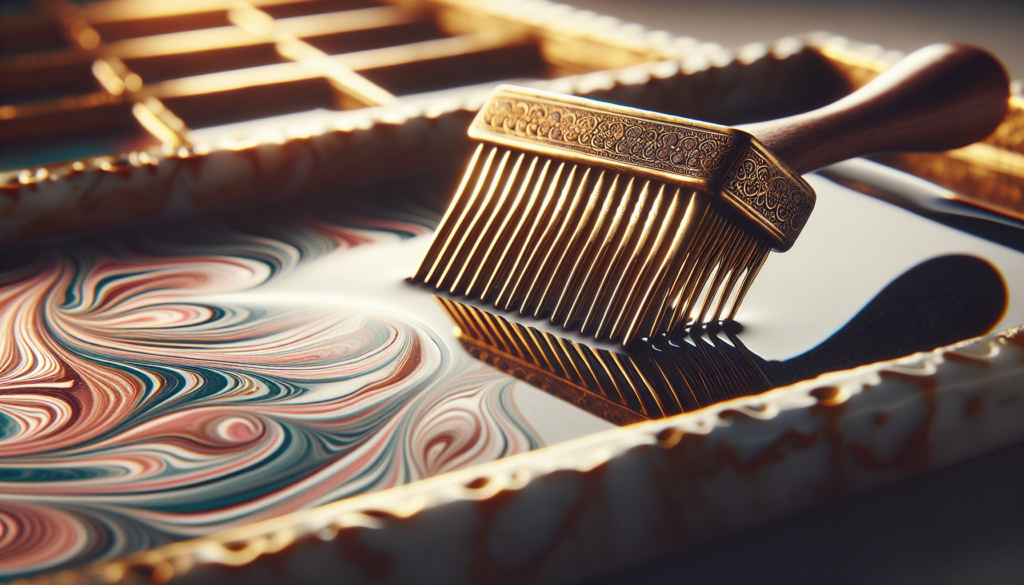
Advanced marblers often make or modify tools for unique effects. You will design combs, rakes, and styluses with specific tooth spacing, curvature, and materials.
Comb and Rake Specifications
Use the table below as a guideline for comb tooth spacing and recommended applications.
| Tooth Spacing (mm) | Effect | Application |
|---|---|---|
| 1–3 mm | Very fine, lace-like details | Miniature feathering, fine nonpareil |
| 4–6 mm | Fine detail, typical feather work | Standard feather patterns |
| 7–10 mm | Bold, graphic ribs | Large-scale feathers, wave accents |
| 10+ mm | Broad, low-frequency patterns | Decorative backgrounds, large waves |
You can create combs by bending thin brass strips and drilling teeth or by 3D printing custom shapes. Ensure edges are smooth to avoid dragging pigment.
Stylus and Needle Variations
Styluses come in many diameters and tip profiles. Use a very fine needle for delicate vein work and a broader, rounded stylus to push broader swaths of paint. Harden wooden handles and weight them for steady hand control.
Transfer, Drying, and Finishing
Transferring your pattern cleanly to paper and finishing it for longevity are as important as the surface work itself.
Transfer Techniques: Timing and Pressure
Transfer timing depends on paint wetness and paper absorbency. You will practice three main transfer approaches:
- Direct quick transfer: Lay paper quickly onto a wet surface for high saturation and blurred edges.
- Slightly set transfer: Allow a few seconds for pattern stabilization before laying paper for crisper lines.
- Soft blot transfer: Use a second sheet to blot before final lift for layered depth.
Lay the paper slowly and uniformly, starting from one edge and lowering to avoid trapping air. Use a clean roller or a flat board to apply even pressure across the sheet.
Drying and Flattening
After transfer, rinse paper gently if required (some techniques call for rinsing to remove excess size). Air dry flat on racks out of direct sunlight. If the sheet cockles, press under weight once fully dry, or run through a dry book press at low pressure with interleaving archival paper. Avoid heat presses that can distort pigments.
Fixing and Varnishing
Many Ebru works are stable without additional fixation if you used lightfast pigments on acid-free paper. If you must varnish for mixed-media work or to add sheen, use archival, non-yellowing fixatives and test on spare samples first. Consider water-based, UV-protective sprays in light mist coats and allow adequate drying time between layers.
Combining Ebru with Other Media
Advanced use often integrates Ebru with calligraphy, printmaking, gold leaf, or collage. You will plan layered sequences so that Ebru patterns serve as backgrounds, insets, or integrated motifs.
Adding Calligraphy and Ink Work
For calligraphic overlays, choose pigmented inks that sit on top of the paper surface. If you plan to use ink directly on the drained paper, ensure the Ebru layer is fully dry and the paper is sized appropriately to accept ink without bleeding. Test nib behavior on prepared samples.
Incorporating Gold Leaf and Metal Foil
Apply gilding after the paper is flattened and dry. Use adhesive size (warm or cold depending on the foil), then carefully lay leaf to accent shapes within the marbling. Mask areas during initial marbling if you want protected un-gilded shapes.
Printmaking and Ebru
You can combine Ebru with relief printing by printing on top of the marbled paper or by using Ebru as an edition background for monoprints. When registering prints over marbled patterns, use transparent inks to let the marbled texture show, or use opaque inks for contrast.
Troubleshooting Common Problems
Even experienced practitioners encounter recurring issues. The table below summarizes common problems, likely causes, and practical solutions.
| Problem | Likely Cause | Solution |
|---|---|---|
| Colors sink or do not float | Paint too heavy or sizing too weak | Thin pigments; increase sizing concentration slightly; test surfactant amounts |
| Irregular spots or rings break | Dust/skin on surface or inconsistent droplet size | Skim surface; standardize droplet release; strain pigments |
| Patterns spread too quickly | Low viscosity or too much surfactant | Add a small amount of additional sizing; reduce surfactant |
| Colors muddy after transfers | Overlapping incompatible pigments | Pre-test pigment interactions; avoid mixing certain pigments in same area |
| Paper sticks or tears during lift | Paper too wet or too adhesive | Try thicker paper or reduce pressure; pre-size paper with alum if necessary |
| Feather lines are uneven | Comb buildup or inconsistent pull speed | Clean comb between passes; practice steady pulls; control hand motion |
When to Rebuild the Vat
If the surface develops persistent issues such as carryover stains, chronic skin formation, or emulsified pigments, rebuild the vat. Dispose responsibly or filter and reuse where safe. Rebuild with fresh sizing and a small test grid before starting important work.
Safety, Archival Practices, and Conservation
You will work safely with pigments and adhesives and plan for the conservation of finished pieces.
Material Safety
Some historic pigments include heavy metals or toxic compounds. Use modern, non-toxic alternatives where possible and wear nitrile gloves when handling concentrated pigments. Ensure adequate ventilation when spraying fixatives or varnishes.
Archival Considerations
Select acid-free papers and lightfast pigments for archival work. Store finished pieces flat in buffered folders or framed behind UV-filtering glass. Avoid long-term exposure to direct sunlight, excessive humidity, or temperature fluctuations.
Long-Term Storage and Documentation
Document your recipes and session conditions for each successful piece. Label work with medium, pigment list, sizing type, and date. This information will be invaluable for conservation or for recreating results years later.
Practice Regimen and Project Ideas
Structured practice accelerates skill acquisition. You will divide time between focused exercises, project work, and experimental sessions.
Practice Exercises
- Daily spread test: 15–30 minutes of consistent droplet tests to calibrate sizing and pigment batches.
- Comb control: 30–45 minutes practicing comb speed, tooth spacing, and angle to create consistent feather repeats.
- Transfer timing tests: 20 minutes creating samples of quick, set, and blot transfers for reference.
Project Suggestions
- Limited edition stationery set: Create a series of marbled papers for cards and envelopes, focusing on repeatable motifs.
- Mixed-media diptych: Produce two harmonized marbled panels and overlay with calligraphic ink to form a visual dialogue.
- Collaborative piece: Marry Ebru backgrounds with another artist’s line work or printmaking for cross-disciplinary exhibitions.
Resources for Continued Learning
Continued refinement comes from deliberate practice, mentorship, and studying historical examples. Seek out workshops with recognized master marblers, reference texts on pigment chemistry, and conservation guides. Maintain a sample library of tests to reference during future projects.
Conclusion
By applying the technical protocols, material knowledge, and structured practice above, you will extend your Ebru work into sophisticated, repeatable, and archival-quality outcomes. You should treat each session as a controlled experiment: document conditions, refine recipes, and methodically train your hand and tools. With a disciplined approach to surface control, pigment behavior, and tool design, you will transform advanced marbling from occasional success into an intentionally reproducible art form.