?Are you trying to find the best paint markers for black paper or other dark surfaces so your colors will pop, your lines will stay crisp, and your work will last?
Introduction
You rely on the right tools when you want vibrant color and reliable coverage on dark backgrounds. Paint markers are among the most convenient solutions for illustrations, lettering, scrapbooking, mixed media, and surface decoration where traditional inks and pencils disappear on black or deep-toned materials.
Why you need paint markers for dark surfaces
Standard pens and many water-based inks were designed for white or light paper and often become invisible on black paper. Paint markers contain opaque pigments or paints formulated to sit on top of dark fibers, giving you strong contrast and consistent coverage.
Paint markers also remove some of the friction and mess of using small brushes and tubes of paint. They let you create solid fills, precise outlines, and metallic accents with predictable flow and minimal setup.
How paint markers differ (basic types)
You should know the major ink types so you can pick markers that match your project and safety preferences.
Acrylic (water-based) paint markers
Acrylic markers use water-based acrylic paint that dries into a permanent, water-resistant finish on most porous surfaces. These are typically low-odor, easy to clean before drying, and suited to fine detail and layering.
Oil-based paint markers
Oil-based markers offer very durable adhesion and strong opacity on non-porous surfaces like glass, metal, and plastic. They generally dry faster to a permanent finish but emit stronger solvent odors and require good ventilation.
Solvent-based and alcohol-based markers
These are more aggressive chemically and are often used for industrial or graffiti applications. They can be extremely permanent and fast-drying but carry strong fumes and require PPE in some contexts.
Gel and pigment ink pens
Gel pens such as certain metallic or neon models can show up well on dark paper but are not true “paint.” They offer smooth flow for fine details but may lack the opacity and durability of acrylic or oil-based paint markers.
Key features to look for
Choosing markers for black paper or dark surfaces means considering a handful of critical features. Each factor influences how the marker performs and how it will behave with your workflow.
Opacity and pigment load
Opacity is the most important metric for dark surfaces. Higher pigment load produces stronger, more uniform coverage with fewer coats. You should prefer markers that advertise “opaque,” “highly pigmented,” or “covering” formulations.
Nib variety and size
Nib sizes determine precision and coverage speed. Fine nibs (0.5–1.2 mm) are best for detail and lettering; medium nibs (2–3 mm) suit general illustration; chisel and broad tips (4–15 mm) are ideal for filling large areas or calligraphy. Replaceable nibs are a plus.
Drying time and smudging
Fast-drying markers let you layer more quickly without disturbing earlier strokes, while slower-drying formulations may allow blending. Balance drying speed with your technique and patience for multiple coats.
Surface compatibility and adhesion
Not every marker sticks equally to every dark surface. Porous black cardstock, canvas, wood, metal, plastic, glass, and coated papers all present different adhesion challenges. Check the manufacturer’s list of compatible surfaces and test on scrap when in doubt.
Refillability and replaceable nibs
If you use markers frequently, refillability and replaceable nibs lower long-term cost and waste. Brands like Molotow and some professional acrylic lines offer refill bottles and spare nibs.
Lightfastness and permanence
For archival or professional work you expect to last, look for lightfast or pigment-based claims. Some markers are formulated for art that resists UV fading; others prioritize bold color over longevity.
Odor and safety
Acrylic (water-based) markers are typically low odor and safer to use indoors. Solvent- and oil-based markers may require ventilation and gloves. Check VOC information if you’re concerned about fumes.
Finish (matte, satin, glossy, metallic)
Different markers dry to different finishes. Choose matte for photography or scan-friendly art, glossy for a varnished look, or metallic/glitter for highlights and accents.
Top paint markers for black paper and dark surfaces
Below is a comparison table to help you quickly see where each marker shines. After the table, you’ll find detailed notes on each option and recommendations for which projects they suit best.
| Marker (Representative model) | Ink type | Best use | Nib sizes | Refillable | Opacity | Price range |
|---|---|---|---|---|---|---|
| Uni Posca (PC series) | Water-based acrylic | All-around art, lettering, scrapbooking | 0.7 mm to brush/chisel | Mostly no | Very high | $$ |
| Molotow One4All (227HS and variants) | Acrylic (professional grade) | Professional artists, murals, mixed media | 1–15 mm + brush | Yes | Very high | $$$ |
| Sharpie Oil-Based Paint Marker | Oil-based | Non-porous surfaces, outdoor use | 1 mm to bullet, chisel | No | High | $ |
| Sakura Pen-Touch | Oil-based paint | Crafting, metallics, glass | 0.9–2.0 mm | No | High | $ |
| Montana Acrylic Marker | Acrylic | Street art, large surfaces, refillable | 2–15 mm | Yes | Very high | $$$ |
| DecoColor (Japan) | Oil-based | Hobby, ceramics, fabric accents | 1–6 mm | No | High | $ |
| Gelly Roll Moonlight | Gel pigmented ink | Fine details, journaling on dark paper | 0.8 mm | No | Medium (good for highlights) | $ |
| Arteza Acrylic Paint Pens | Acrylic | Budget friendly for beginners | Fine to medium | No | Good | $ |
Note: $ = budget, $$ = mid-range, $$$ = premium/professional.
Uni Posca — best all-rounder for black paper
Uni Posca markers are a consistent favorite because their water-based acrylic ink is highly opaque, low odor, and versatile across paper, wood, canvas, and even some plastics. You can build smooth layers, blend wet-on-wet, and clean up with water before drying.
Pros: excellent opacity on dark paper, low odor, many nib options, good color range.
Cons: not all sizes are refillable; some larger sizes are pricey.
Recommended use: hand lettering, illustration, scrapbooking, and mixed media where you want bright, opaque colors without strong fumes.
Molotow One4All — professional, refillable acrylics
Molotow One4All markers use high-concentration acrylic pigments rated for lightfastness and offer refill bottles and replaceable nibs. They are made for artists and muralists who want archival-quality results and long-term cost efficiency.
Pros: refillable, very opaque, durable finish, excellent for professional work.
Cons: higher initial cost, may be overkill for casual hobbyists.
Recommended use: professional illustrations, large-format work, archival pieces.
Sharpie Oil-Based Paint Markers — durable on non-porous surfaces
Sharpie’s oil-based paint markers are strong on metal, glass, and plastic and dry to a durable finish. They are widely available and work well for crafts where permanence on smooth, dark surfaces is crucial.
Pros: adheres to many non-porous surfaces, quick-drying, affordable.
Cons: solvent odor, not ideal for heavy layering on paper.
Recommended use: labeling, decorating glass or metal, outdoor crafts (check waterproof claims).
Sakura Pen-Touch — craft-friendly opaque paint
Sakura Pen-Touch markers are oil-based and come in metallic and solid pigment varieties. They’re popular for crafts, glass decorating, and holiday projects where metallic accents on black backgrounds are desired.
Pros: bright metallics, opaque white, good flow.
Cons: solvent odor, some users report clogging in fine nibs.
Recommended use: metallic accents, ceramics (check manufacturer instructions for heat-setting), craft projects.
Montana Acrylic Marker — professional street and studio use
Montana’s acrylic markers match the brand’s high-pigment spray paints, offering very opaque coverage and interchangeable nibs. They’re refillable and suited for both studio and urban art.
Pros: heavy coverage, refillable, replaceable nibs, wide nib selection.
Cons: premium price, some solvent/odor in certain formulations.
Recommended use: murals, sign painting, larger artwork where bold coverage and durability matter.
DecoColor and similar oil-based hobby markers
DecoColor markers are widely used in crafting, ceramics, and DIY projects for their strong coverage and variety of finishes. They perform well on dark papers and are inexpensive.
Pros: reliable coverage, good price, many finishes.
Cons: solvent odor, not always archival.
Recommended use: hobby projects, ceramics, fabric accents (follow setting instructions if applicable).
Gelly Roll Moonlight and other gel pens — fine details and highlights
Gelly Roll Moonlight pens are pigmented gel ink pens that are formulated to show on dark paper. While not true paint, their luminous and fluorescent colors are excellent for fine lines, stippling, and journal highlights.
Pros: fine detail, comfortable flow, available in fluorescent and metallic.
Cons: less durable than paint markers; not ideal for heavy layering or outdoor exposure.
Recommended use: fine detailing, journaling, accent strokes on black paper.
Arteza Acrylic Paint Pens — budget-friendly option
Arteza offers acrylic paint pens that perform admirably for their price. They are a good entry point for beginners who want opaque coverage on dark paper without high cost.
Pros: affordable, water-based, decent opacity.
Cons: inconsistent flow in some batches, fewer nib options than premium brands.
Recommended use: school projects, beginners, casual crafting.
Detailed buying guide — matching markers to your needs
Selecting the best paint marker depends on your specific application. Use these practical considerations when narrowing choices.
For calligraphy and hand lettering
You should choose markers with chisel or brush nibs for strokes that need varying line widths and smooth transitions. Water-based acrylics like Posca or medium-size Montana nibs offer the control and reworkability needed for elegant letterforms on black paper.
For illustration and fine line work
Fine nibs with steady ink flow are critical. Uni Posca in fine sizes or gel pens for the finest details give you crisp control and predictable coverage.
For large fills and murals
You’ll want larger nibs, strong pigment concentration, and refillability. Molotow One4All and Montana Acrylic Markers are purpose-built for this, enabling you to replace nibs and refill paint to save cost and reduce waste.
For non-porous surfaces (glass, metal, plastic)
Oil-based and certain solvent-based markers provide the best adhesion. Test first: some acrylic water-based markers will not adhere well or may scratch off. Sharpie Oil-Based and Sakura Pen-Touch are solid choices here.
For metallics and special effects
Metallic, iridescent, and glitter markers work well as accents on black paper. Sakura Pen-Touch and certain Posca metallic versions deliver strong highlights. Remember that metallic pigments often reflect light differently and may require a darker base or multiple passes to read as metallic in photos.
For archival work or professional pieces
If longevity is key, select markers with lightfast pigments and proven permanence. Molotow One4All advertises pigment-heavy formulas and is often preferred by professional artists. Consider sealing the finished piece with a compatible varnish for extra protection.
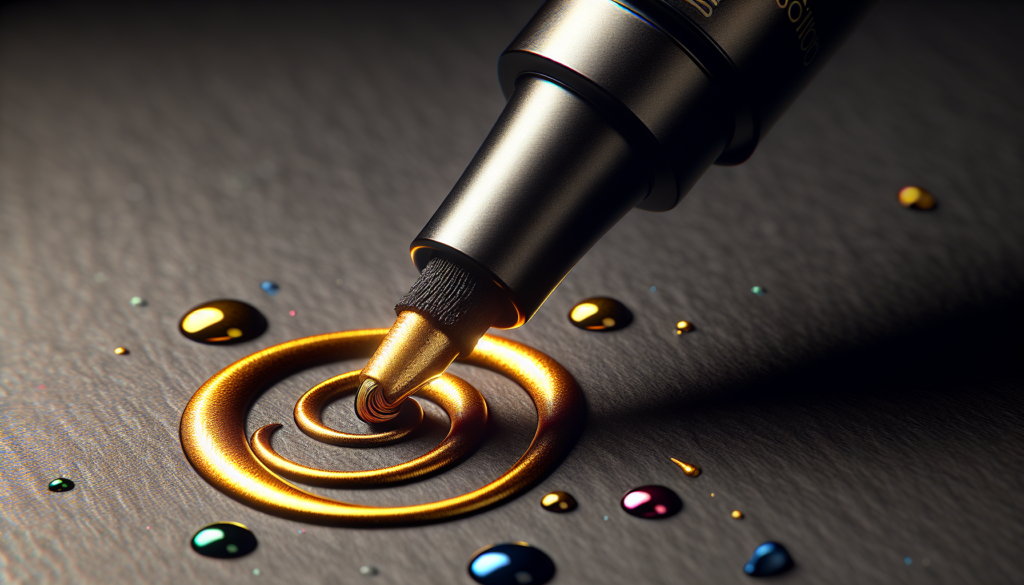
How to use paint markers on black paper and dark surfaces
Follow a consistent workflow to get the best results and avoid problems.
Surface preparation
You should make sure the surface is clean, dry, and free of oils or dust. For non-porous surfaces, lightly scuffing the area with fine sandpaper increases adhesion for oil and acrylic markers.
Test on scrap
Always test on a similar scrap of the exact black paper or surface you’ll use. This reveals how many layers are needed for full coverage, how the stroke looks, and whether the ink sands, beads, or soaks in.
Shake and prime markers
Most paint markers require vigorous shaking (with a ball-bearing agitator) and pressing the nib to the surface to prime the flow. The initial few presses may come out uneven; wipe a little on scrap until flow stabilizes.
Work in thin layers
Instead of saturating a single area with thick paint, apply thin coats and let each dry fully. This reduces cracking, improves drying time, and yields a more uniform finish.
Blending and mixing
Acrylic markers can be blended when wet, but do so quickly. For complex blends, you may prefer to mix color on a palette and use a brush. Solvent and oil-based markers blend differently — read manufacturer notes.
Sealing your finished work
To protect your piece, consider spray varnish or a compatible fixative. Use a non-yellowing, archival spray for long-term pieces. Test sealing on a sample first, as some varnishes can alter sheen or color.
Troubleshooting and maintenance
You will inevitably run into common issues. These troubleshooting steps will help you recover and maintain your markers.
Marker clogged or dry
Solution: For water-based acrylic markers, soak the nib briefly in warm water and prime again. For oil/solvent markers, follow the manufacturer’s priming instructions; in severe cases the marker may be unusable.
Inconsistent flow or sputtering
Solution: Shake thoroughly and keep the marker horizontal during storage if recommended by the maker. Press the nib slowly and repeatedly on scrap until pigment reaches the tip consistently.
Smudging after application
Solution: Allow more drying time between layers. Use fast-drying markers for detail work, or lightly heat with a hairdryer on low to speed curing (test first).
Cracking on large fills
Solution: Apply thinner coats and let each dry. Thick single coats of acrylic may crack as they cure. Seal with flexible varnish to reduce brittleness on textured or movable surfaces.
Adhesion failure on non-porous surfaces
Solution: Lightly sand the area or apply a primer designed for the surface. Choose oil-based markers if acrylic adhesion remains poor.
Storing markers
General guidance: follow the manufacturer’s instructions. Most water-based and acrylic markers are best stored horizontally to keep pigment lubricated across the nib; some oil-based markers may be stored tip-down to keep pigment near the tip. When in doubt, check the label.
Project ideas and practical tips
You should match the marker to the project to maximize success. Below are concrete ideas and tactics that work particularly well on dark surfaces.
Hand-lettered cards and invitations
Use Posca fine or medium nibs to create crisp white or colored lettering. For metallic accents, add Sakura Pen-Touch highlights after the base color dries.
Poster and signmaking
Choose broad chisel tips and refillable markers like Molotow or Montana for speed and large coverage. Layer dark-to-light for strong contrast.
Mixed-media journals
Combine gel metallic pens for detail with acrylic paint markers for opaque backgrounds. Use masking tape to create clean geometric sections.
Decorative glass and ceramics
Select oil-based markers designed for glass or those with recommended baking instructions to set the paint. Follow the manufacturer’s heat-setting instructions carefully.
Photo and scan considerations
Matte finishes scan better and produce fewer reflections; if you plan to scan your work, prefer matte or satin markers and avoid glossy metallics unless you photograph instead.
Safety and environmental considerations
You must be aware of the health and environmental implications of your marker choices.
- Use water-based acrylic markers indoors with minimal ventilation for comfort.
- Use solvent and oil-based markers in well-ventilated areas; consider a respirator for long sessions.
- Dispose of empty markers and solvent properly according to local hazardous-waste guidelines.
- Refillable systems reduce plastic waste; choose refillable markers if sustainability matters to you.
Where to buy and price expectations
You can find most mainstream paint markers at art supply stores, large craft retailers, and online platforms. Expect:
- Budget markers: $1–$5 per marker or $10–20 per basic set.
- Mid-range (Posca, Sakura): $3–$12 per marker depending on nib size.
- Professional/refillable (Molotow, Montana): $8–$20 per marker; refills sold separately.
Buying tips: purchase individual markers to test nibs and colors before committing to large sets. Look for compatible nib spare parts and refill bottles if you plan frequent use.
Final recommendations
To narrow your choice quickly, consider what you’ll do most often:
- Best overall for black paper and dark surfaces: Uni Posca (consistent opacity, low odor, wide nib range).
- Best professional/refillable option: Molotow One4All (archival pigments, refills, replaceable nibs).
- Best for non-porous surfaces and long-term durability: Sharpie Oil-Based Paint Marker or Sakura Pen-Touch (choose oil-based).
- Best budget starter: Arteza Acrylic Paint Pens or generic acrylic sets (good for practicing techniques).
- Best for fine details and journaling: Gelly Roll Moonlight (pigmented gel pens show up well on dark paper).
Summary
You’ll get the best results on black paper and other dark surfaces when you choose markers specifically formulated for opacity and adhesion, match nib size to the job, and follow proper preparation and layering techniques. Start with a small selection of proven markers like Posca or Molotow to test how they interact with your specific surface, and expand to specialty markers (metallics, oil-based) as your project needs evolve.
If you tell me what surfaces, project types, and budget you have in mind, I can recommend a specific set of markers and nib sizes tailored to your work.